
AI Literacy for English Teachers: It’s Not Which Tool You Use, but Why You Use It

From using AI tools to making pedagogical decisions
Artificial intelligence is entering the English teacher’s world as much more than another application or a shortcut for generating content. From lesson planning and creating level-appropriate texts to speaking practice and feedback, AI is beginning to reshape the way teachers work.
But there is an important distinction.
A good English lesson is not designed by the teacher who knows the greatest number of AI tools. It is designed by the teacher who can explain which tool to use, why to use it, when to use it and within what boundaries.
So, in 2026, what teachers really need is not another list of “The 20 Best AI Tools for Teachers.”
What they need is AI literacy.
UNESCO’s AI Competency Framework for Teachers approaches teacher competency across five dimensions: a human-centred mindset, ethics of AI, AI foundations and applications, AI pedagogy, and AI for professional learning. Its 15 competencies are organised across three progression levels: Acquire, Deepen and Create.
This perspective moves AI literacy beyond learning how to operate a particular application and places it where it belongs: within the realm of pedagogical judgement.

Why Should We Think Differently About AI Literacy in English Language Teaching?
Choosing technology in a language classroom is never purely a technical decision.
When evaluating an AI tool, teachers need to consider whether the English it produces is appropriate for the learner’s level, what cultural assumptions it may contain, how accents and dialects are represented, how student data is processed, and whether the interaction it creates actually provides meaningful opportunities for communication.
A 2026 study published in Frontiers in Education conceptualises AI literacy among foreign language teachers across six dimensions: conceptual understanding, technical proficiency, pedagogical integration, adaptive expertise, ethical reasoning and self-efficacy.
The study also highlights an important point for language education: general measures of AI literacy may not be sufficient on their own. Context-sensitive professional judgement matters.
That is why a teacher’s first question should not be:
“What can this tool do?”
A better question comes first:
“What language skill should my students develop by the end of this activity?”
For example, if the goal is speaking fluency, having AI write a perfect dialogue for the student does not achieve the learning objective.
The learner needs to negotiate meaning, respond to unexpected questions, ask for clarification and develop their own way of expressing ideas.
AI can serve as a conversation partner, an idea generator or a rehearsal environment. But it should not become the autonomous actor making learning decisions on behalf of the student.
The British Council’s human-centred approach to AI similarly emphasises putting pedagogical purpose before technology, maintaining the central role of educators, and considering accessibility and inclusion.
A Five-Question AI Decision Framework for Teachers
Before bringing an AI tool into your English classroom, ask yourself these five questions.
1. PURPOSE — Why am I using AI?
Does the tool genuinely support the vocabulary, grammar, reading, writing, listening or speaking objective I have identified?
“Making the lesson look more technological” is not a pedagogical objective.
If using AI makes no meaningful difference to student learning compared with not using it, there may be no reason to introduce the technology.
2. HUMAN CONTRIBUTION — What will the student actually do?
While AI performs the task, is the learner simply consuming its output?
Or is the student comparing, questioning, correcting, choosing, recreating and justifying decisions?
If students contribute less intellectually and linguistically after AI is introduced, the technology may be reducing rather than expanding opportunities for learning.
3. RELIABILITY — Who will check the output?
AI-generated English can sound perfectly natural and still be inaccurate, inappropriate for the context or beyond the learner’s level.
Teachers and students therefore need to develop a simple habit:
Generate → Check → Compare → Decide
Dictionaries, course materials, reliable sources and teacher expertise remain part of the process.
4. RISK — What are we giving in return?
Are students entering their names, photographs, voices or other personal information into the system?
Is the tool appropriate for their age group?
Could it generate biased or stereotypical language?
Could it produce material with copyright implications?
Could unequal access to advanced AI tools create inequalities between learners?
AI literacy is not simply about getting better results from AI. It is also about understanding which risks we are willing to accept.
5. ALTERNATIVE — Would this activity be better without AI?
This may be the question we ask least often.
Not every teaching problem requires a technological solution.
Students asking questions of one another, personalised teacher feedback, classroom discussion or a conversation with another human being may sometimes provide far greater educational value than AI.
An AI-literate teacher knows not only when to use AI, but also when not to use it.

Small but Meaningful Applications in the English Classroom
Reading
A teacher might use AI to create two versions of the same reading text at different proficiency levels.
Instead of simply giving students the generated texts, however, the teacher could ask:
Which version is more appropriate for a B1 learner?
Which words make the text unnecessarily difficult?
Which sentence sounds more natural?
Has any meaning been changed during simplification?
AI then moves from being an automatic material generator to becoming an object of critical language awareness.
Speaking
AI can suggest role cards or follow-up questions based on students’ interests.
But the actual conversation can still take place between students.
Learners need to understand another person’s question, ask for clarification when necessary, change the direction of a conversation and use communication strategies in real time.
Writing
Instead of asking AI:
“Write me a 250-word essay,”
students can give it much more limited tasks:
Show me the repetition in this paragraph.
Suggest three alternative linking words.
Explain why this sentence does not sound natural.
Identify vocabulary that may be too advanced for a B1 learner.
The final decision should always remain with the student.
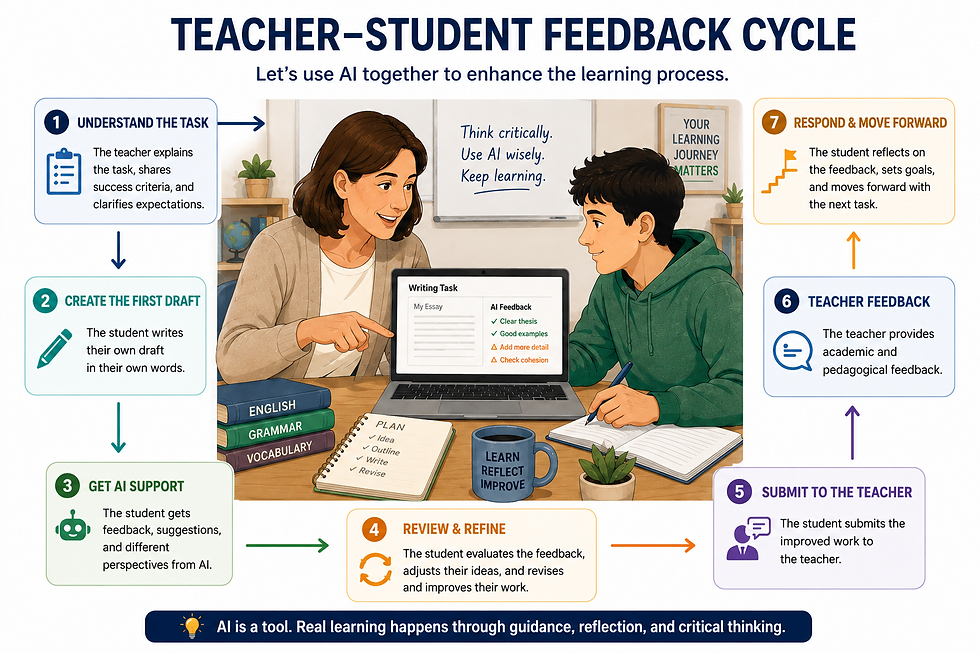
AI Literacy Is Not the Teacher’s Responsibility Alone
Schools and educational leaders also have an important role to play.
If every teacher within an institution independently begins using different AI tools, this can create challenges around data privacy, student safety, assessment and equitable access.
Article 4 of the European Union’s AI Act requires organisations using AI systems to take measures to ensure an appropriate level of AI literacy among staff dealing with those systems. The approach should take into account factors such as employees’ technical knowledge, experience and training, as well as the context in which AI systems are used.
School leaders can begin with three simple steps:
1. Understand current practice.Which AI tools are teachers already using? In which classes, and for what purposes?
2. Establish principles before creating a tool list.What data should never be shared? Where is human oversight mandatory? When should students be informed that AI is being used?
3. Give teachers opportunities to experiment and share.Instead of relying on a one-off “AI training session,” create regular professional learning opportunities where teachers can test small classroom applications and discuss the results with colleagues.
An institutional AI policy should not simply be a list of prohibitions.
A good policy should answer not only:
“What are you not allowed to do?”
but also:
“How can you make better decisions?”
Conclusion: An AI-Literate Teacher Is Not a Teacher Who Uses Every Tool
The future strength of English teachers will not come from producing content faster than artificial intelligence.
It will come from their ability to bring together learning objectives, human interaction, ethical boundaries and linguistic quality within the same pedagogical decision.
An AI-literate teacher is not someone who tries to bring every new tool into the classroom.
It is a teacher who can design AI-supported learning without allowing AI to think on behalf of the student; who can question its output, recognise its risks, protect student voice and autonomy, and, when necessary, confidently say:
“We don’t need AI for this lesson.”
The sustainable future of artificial intelligence in English language education will not begin with using more tools.
It will begin with making better pedagogical decisions.
References
UNESCO — AI Competency Framework for Teachers
Ren & Li (2026) — Assessing Artificial Intelligence Literacy in Foreign Language Teachers: A TPACK-Based Perspective
British Council — Human-Centred AI: Lessons for English Learning and Assessment
European Commission — AI Literacy: Questions & Answers


Yorumlar