
Process-Oriented Assessment in the AI Era: Evaluating the Student’s Learning Journey, Not the AI-Generated Output


The teacher’s new role is to become a designer of decisions.
Artificial intelligence can enable an English learner to produce a polished-looking paragraph within seconds. But a polished paragraph, by itself, is not evidence of learning. In 2026, the key question is no longer “Did AI write this text?” but rather, “How did the student plan it, question it, improve it through feedback, and what can they explain using their own English?”
Introduction: The Problem Is Not the Presence of AI, but the Invisibility of Learning Evidence
For English teachers, generative AI represents both support and uncertainty at the same time. A student can use an AI tool for vocabulary choice, grammar, speaking practice, or written feedback. At the same time, teachers may struggle to distinguish between what the student has genuinely produced and what has been generated by the tool, to verify the accuracy of the response, and to maintain fair assessment practices.
This does not mean that English assignments must be completely banned or that assessment should be handed over to an AI-detection tool. A more robust solution is to change what we assess: not only the final product, but also the learning process and the evidence produced throughout that process.
In Türkiye, this approach has a strong policy foundation. The Ministry of National Education’s Artificial Intelligence in Education Policy Document and Action Plan 2025–2029 provides a broad framework ranging from teacher training and AI-supported assessment to personalised learning and the analysis of foreign-language skills. The document envisages the wider use of AI-supported applications capable of analysing vocabulary, grammar, listening, speaking, reading and writing skills in foreign-language education.
“In-service training programmes will be planned to improve teachers’ competence in AI-supported lesson design, enabling them to adapt to AI-enhanced pedagogical processes and use these technologies effectively.” — Ministry of National Education, Artificial Intelligence in Education Policy Document and Action Plan 2025–2029
Therefore, what an English teacher needs in 2026 is not simply another list of new tools. What is needed is a pedagogical assessment design that defines when, why and within what boundaries AI should be used.
The Shared Trend in 2026: AI Under Teacher Guidance, Not in Place of the Teacher
Current discussions in ELT are converging around four major trends.
First, AI is increasingly positioned as an assistant that supports both teachers and learners in areas such as lesson planning, material development, speaking practice and written feedback.
Second, AI literacy now extends far beyond the ability to write a prompt. It includes the ability to verify outputs, identify bias, protect personal data and preserve the learner’s own voice. Cambridge English particularly emphasises the importance of critically checking AI-generated content for inaccuracies, bias and suggestions that may be inappropriate for the task.
The third trend is a return to authentic and formative assessment. As Pearson highlights in its 2026 discussion of language teaching and assessment, good assessment should not merely test language knowledge; it should also make visible the learner’s ability to use language in authentic communicative tasks. Monitoring progress through small, meaningful steps, providing feedback and documenting development are therefore becoming increasingly important.
The fourth trend is human-centredness. UNESCO highlights data privacy, age appropriateness, ethical validation and pedagogical design as key principles for the use of generative AI in education. For AI to have a meaningful role in education, it must be used safely, fairly and in a human-centred way, rather than being valued simply for speed or automation.
Together, these trends suggest one practical principle for English teachers:
AI should not produce the final answer. It should support the learner in thinking, experimenting, checking and revising.
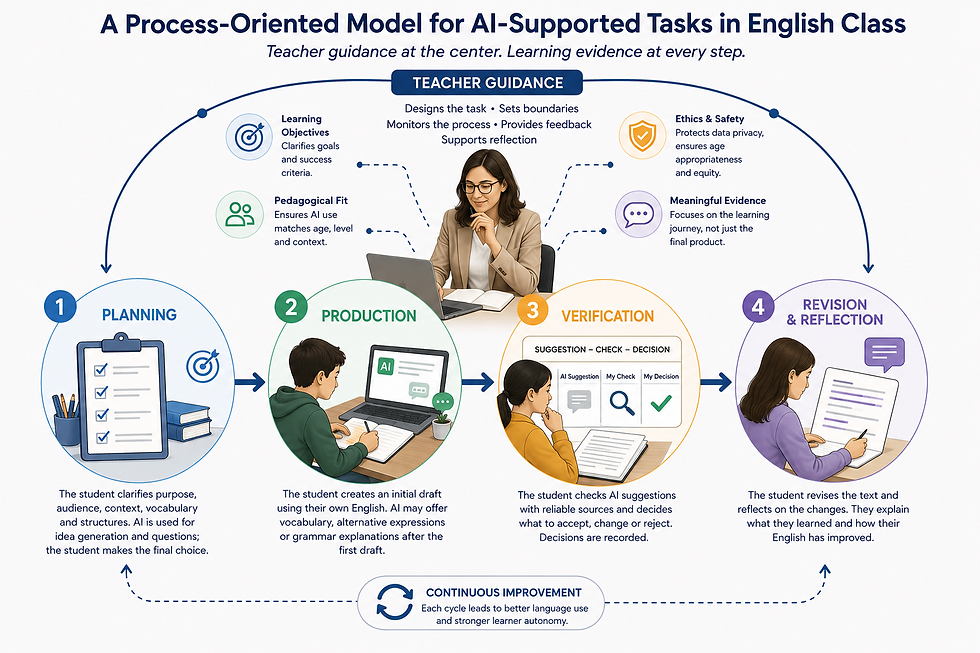
Moving from Product to Process: A Four-Stage Classroom Model
The English Language Curriculum within the Türkiye Century Education Model places strong emphasis on performance-, competency- and process-based assessment. It highlights the importance of experiencing process components in achieving learning outcomes and, in writing, stresses planning, drafting, rewriting through feedback and improving the final text. The curriculum also addresses the appropriate use of technology- and AI-based tools according to learners’ age, level, context and learning objectives.
To bring this framework into the classroom, every AI-supported task can be designed around four stages.
1. Planning: The Student Should Explain What They Are Producing and for Whom
A task should not be as general as simply saying, “Write a text in English.” Students should be asked to define their purpose, target audience, communicative context, target vocabulary and the language structures they intend to use.
For example, if a student is preparing a short English guide introducing their school to international visitors, the target audience, function of the text and success criteria can all be clearly established in advance.
If AI is used at this stage, the tool should not be asked to write the text directly. Instead of saying, “Give me the answer,” a student might prompt:
“Suggest three different ideas for this task; I will make the final decision.”
For the teacher, the evidence is not an AI screenshot. It is the student’s short planning note explaining why they selected a particular idea.
2. Production: The First Draft Should Reveal the Student’s Thinking
A student’s first draft does not need to be perfect. In fact, from a learning perspective, it is valuable precisely because it reveals which words the learner knows, which structures they are attempting to use and where they need support.
For this reason, at least part of the initial production can be completed in class, within a limited period of time and through the student’s own independent work.
Even in tasks where AI assistance is permitted, students can first be asked to produce their own sentences. AI can then provide alternative expressions, vocabulary suggestions or grammatical explanations.
Rather than asking AI to rewrite the entire text, Pearson recommends an approach such as:
“Identify three errors and explain why they are errors. Do not rewrite the entire text.”
This preserves the learner’s responsibility for making corrections.
3. Verification: AI Output Should Never Be Accepted as Automatically Correct
AI may produce an expression that sounds natural but is inappropriate for the context. A grammatical explanation may be incomplete, or the information provided may simply be inaccurate.
Verification should therefore be designed as a separate stage of the learning task.
Students can compare an AI suggestion with a reliable dictionary, course material, teacher feedback or another trustworthy source.
One practical method is to ask students to keep a simple three-column record:
AI suggestion
My verification
My final decision
Students can explain why they accepted, modified or rejected a suggestion. In this way, the teacher is assessing not only the final sentence, but also the learner’s ability to make critical decisions.
4. Revision and Reflection: Learning Becomes Visible Through Change, Not Just Through the Final Product
The final draft should not merely be a corrected copy of the first one. It should reveal what the learner changed as a result of feedback.
Students can be asked to identify two or three significant changes and briefly explain each one:
“I changed this word because…”
“I chose this sentence structure because…”
“I did not use the AI suggestion because…”
As a final step, a short oral defence or individual reflection can be added. The learner might explain the text to a classmate, justify the use of a particular language structure, or reformulate one of their sentences in a different context.
This strengthens the connection between the written product and authentic language use.
A Practical Classroom Task
Task: Prepare a 150–180-word English guide entitled “Welcome to Our School” for an international visitor, together with a 60-second spoken introduction.
The text should include at least three features of the school, two expressions for giving directions and one recommendation.
This task can be adapted for A2–B1 learners. At lower levels, sentence frames and vocabulary banks can be provided. At higher levels, students can be asked to adjust their register for the target audience and include a cultural explanation.
Stage: Planning
Student evidence: Target audience, purpose, vocabulary and structure list.
Teacher focus: The communicative purpose of the task.
Permitted role of AI: Generating ideas and asking questions; the student makes the final choice.
Stage: Initial Production
Student evidence: First in-class draft and spoken rehearsal.
Teacher focus: Independent language use.
Permitted role of AI: Limited feedback after the first draft.
Stage: Verification
Student evidence: A “suggestion–check–decision” record.
Teacher focus: Source checking and appropriacy.
Permitted role of AI: Suggesting errors or alternative expressions, not guaranteeing accuracy.
Stage: Revision
Student evidence: Marked second draft.
Teacher focus: Development through feedback.
Permitted role of AI: Supporting explanation and comparison.
Stage: Reflection
Student evidence: A 3–5 sentence learning reflection or short oral defence.
Teacher focus: The learner’s ability to explain their own voice and decisions.
Permitted role of AI: AI must not provide the explanation on behalf of the student.
In this model, the use of AI is not the purpose of the task. The goal is for students to use English in an authentic communicative context and to manage the support they receive in a critical and responsible way.
A Simple and Defensible Assessment Rubric
Each school should determine its own assessment criteria and weightings. The following framework can help prevent an AI-supported task from being reduced to the quality of the final written product alone.
Communicative Purpose
Beginning: The message and target audience are unclear.
Developing: The purpose is partly understandable.
Expected: The message is appropriate for the target audience.
Advanced: The message is clear, effective and sensitive to context.
Language Use
Beginning: Vocabulary and structural range are limited.
Developing: Errors occasionally interfere with meaning.
Expected: Target structures are generally accurate and understandable.
Advanced: Language choices are accurate, varied and meaningful.
Evidence of Process
Beginning: No planning or draft record is available.
Developing: Some stages of the process are visible.
Expected: Planning, first draft, verification and revision records are available.
Advanced: The student can justify decisions with evidence.
AI Literacy
Beginning: AI output is used without questioning.
Developing: Some suggestions have been checked.
Expected: Suggestions are compared with reliable sources.
Advanced: The student can discuss errors, bias, appropriacy and data-privacy considerations.
Reflection and Student Voice
Beginning: The student cannot explain the changes they made.
Developing: The student can identify a few changes.
Expected: The student explains important changes and the reasons behind them.
Advanced: The student clearly identifies their own learning strategy and next learning goal.
This rubric is more meaningful than simply grading whether a student “used AI or did not use AI.” What is being assessed is not the use of the tool itself, but the learner’s linguistic production, critical evaluation, response to feedback and responsibility for their own learning.
Five Questions Teachers Can Ask Before Using AI
Before integrating AI into a lesson or task, teachers can ask themselves five questions:
Does this tool genuinely contribute to the language-learning objective I have identified?
If the tool merely generates a text quickly, the task may need to be redesigned.
Will the student be able to explain the tool’s suggestion and reject it when necessary?
If the student cannot make decisions independently, AI support may obscure learning rather than strengthen it.
Does the task require the sharing of personal data, a student’s name, photograph, voice recording or other sensitive information?
If so, data minimisation and the school’s relevant policies should take priority. UNESCO identifies data privacy and age appropriateness as core principles for the use of generative AI in education.
What source will be used to verify the AI output?
A dictionary, coursebook, teacher check or another reliable source should be built into the task.
Will the student communicate in English with a real person?
AI can provide speaking rehearsal, but interaction with classmates, teacher feedback and authentic communication should remain at the centre of the task.
These questions do not require the use of any particular commercial product. On the contrary, they ensure that the teacher defines the pedagogical purpose before selecting the tool.
Three Approaches to Avoid
First, grading students solely on the result of an AI-detection tool is not a reliable assessment design. A detection result may provide a reason for further investigation, but it should never replace direct evidence of learning such as planning notes, drafts, classroom performance and oral explanation.
Second, attempting to eliminate all AI use through a blanket ban can reduce opportunities for students to develop the AI literacy they increasingly need. A more effective approach is to teach clearly which uses are permitted, which are restricted and which conflict with the purpose of a particular task.
The European Centre for Modern Languages’ 2024–2027 “AI for Language Education” project similarly emphasises teacher guidance across areas including lesson planning, materials development, formative assessment, plagiarism and cheating.
Third, accepting AI-generated text as if it were entirely the student’s own work makes the most important part of language learning invisible.
When students submit a text, they should be able to demonstrate not only that they have a “correct answer,” but also what they changed, why they changed it and which decisions they made themselves.

A Practical Starting Plan for the First Week
Teachers do not need to wait for a comprehensive school-wide AI policy before experimenting with a small, low-risk task.
In the first lesson, students can examine a short example illustrating the strengths and weaknesses of AI. They might compare two AI-generated responses to the same prompt and discuss differences in accuracy, naturalness and appropriacy.
In the second lesson, students can define their own goals and success criteria and produce a short first draft.
In the third lesson, they can use carefully selected AI support to review suggestions, compare them with reliable sources and keep a record of their decisions.
In the fourth lesson, students can revise their texts, present them orally and explain which changes contributed most to their learning.
The purpose of this four-day sequence is not to stage a technology demonstration. It is to make the learner’s learning trail visible.
The same model can even be used in schools with limited internet access. The teacher can bring a pre-prepared AI-generated text into the classroom, and students can correct it, compare it with reliable sources and produce an improved English version.
Conclusion: The Teacher’s New Role Is to Be a Designer of Decisions
In 2026, the role of the English teacher should not be reduced to acting as an “output gatekeeper” who checks every sentence produced by AI.
The teacher is the person who defines the learning objective, places the task within an authentic communicative context, sets the boundaries of AI support, makes student decision-making visible and connects feedback to the learning process.
Current policy developments in Türkiye, the process- and performance-oriented emphasis of the Türkiye Century Education Model, international AI-literacy frameworks and ongoing ELT discussions in 2026 all point in the same direction:
What should be assessed in the English classroom is not merely the final text. It is the way the student plans, produces, verifies, revises and preserves their own voice throughout the learning process.
When AI supports this process, it does not replace the teacher. Instead, it helps teachers collect more meaningful evidence of learning.
And this is precisely where the sustainable future of artificial intelligence in English language teaching begins.


Yorumlar